

공정 노하우
필름 세척 후 수분을 줄이는 방법
필름은 플레이크와는 다르게 수분을 머금습니다. 바로 그 차이 때문에 필름 라인은 보틀 라인의 건조 방식을 그대로 복제할 수 없습니다.

필름 세척 후 수분을 줄이는 방법
핵심 요약
- Mechanical dewatering should always do the bulk of the work; thermal drying removes what is left.
- Film retains water in layers, folds and surface texture in a way that rigid flake does not.
- A film squeezer removes water by force and is far cheaper per litre removed than a dryer.
- Thermal drying is sized around the moisture the downstream process can accept, not around a target figure chosen in advance.
- Drying before storage matters as well as drying before extrusion — wet film can heat and degrade in a bale or silo.
Why film is different
Washed rigid flake drains well. Water sits on the surface and runs off, so a centrifuge or a screen can remove most of it quickly. Film does not behave that way. It folds, it layers, it holds water in the gaps between layers and in the texture of the surface, and it does not drain under gravity.
That is the whole problem. It is not that film is wetter in principle — it is that the water is held in a structure that gravity cannot drain.
Mechanical dewatering comes first
The economical sequence is always mechanical first, thermal second. Mechanical dewatering removes the bulk of the free water using force rather than heat, and the cost per litre removed is a fraction of what a dryer costs for the same job.
Mechanical options:
- 압착 — the material is compressed between a screw and a perforated barrel or cone. For
film this is the most effective single stage, because it removes water from between the layers rather than only from the surface.
- Centrifuging — effective for flake and for material that flows; less effective for film that
mats.
- Drainage and vibration screens — useful as a first step to remove free water before the
mechanical stage, and cheap to run.
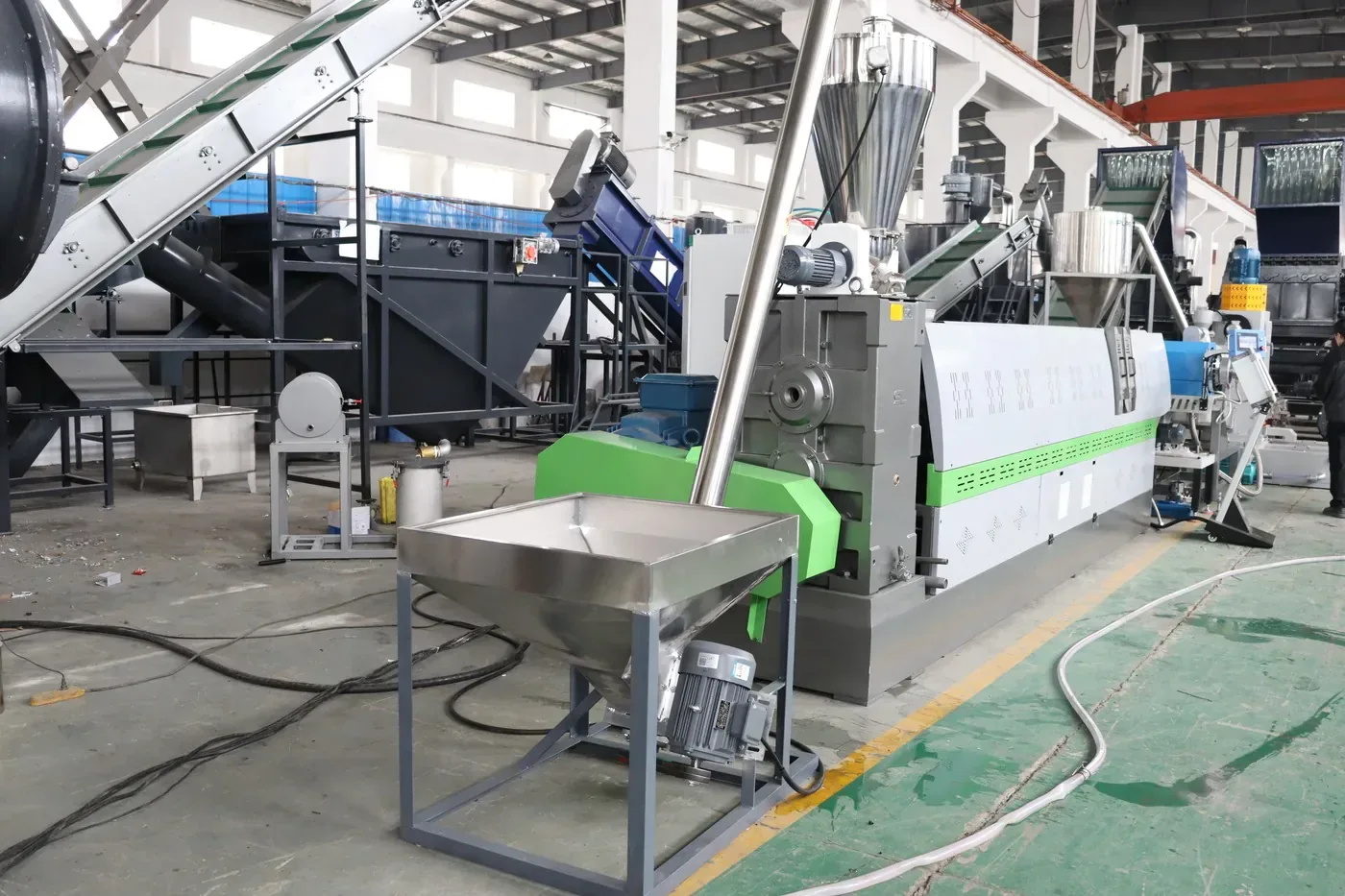
The film squeezer exists because of this specific problem. It is not a general-purpose dryer; it is a machine designed to remove water from film mechanically, and it is normally the stage that decides whether thermal drying is affordable at all.
Thermal drying removes what is left
Thermal drying — hot air, usually in a staged or belt dryer — removes the remaining surface moisture. Three practical points:
- Size it after the mechanical stage. A dryer sized for the moisture content leaving the
squeezer is much smaller than one sized for the moisture content leaving the washing tank.
- Airflow matters as much as temperature. Film mats easily, and a mat has a dry outside and a
wet inside. Good airflow through the material is what makes the dryer work.
- More heat is not more drying. Excess temperature can soften or degrade film without
removing additional water, and it raises energy cost for no benefit.
What moisture level is "dry enough"
There is no universal target. It is set by what happens next:
| Next step | What matters |
|---|---|
| Extrusion / pelletizing | Residual moisture becomes steam in the extruder and must be vented or degassed |
| Storage or baling | Moisture promotes heating, odour and biological activity in the bale |
| Sale as washed film | Moisture is weight the buyer pays for, and it affects downstream processing |
| Further washing | Additional moisture is largely irrelevant |
Because the target depends on the destination, the drying configuration is decided with the whole process route, not on its own.
Degassing is the backstop
Where moisture cannot be removed economically before extrusion, the extruder can be configured to remove it — vacuum venting, or a two-stage arrangement that exposes the melt twice. This is a legitimate route, but it is more expensive to run than removing water mechanically, so it is normally the second choice rather than the first.
A practical order of checks
- Is the dewatering stage actually working, or is material bypassing it?
- Is the material reaching the dryer in a mat, or spread enough for air to pass through?
- Is the dryer airflow adequate, and are the air paths clear?
- Is the moisture target being set by the downstream process, or has it been assumed?
- If moisture still exceeds the target, is degassing the right answer — or is the drying stage
undersized?
관련 항목: 세척 라인의 각 기계가 하는 역할 · 플라스틱 세척 시스템 · LDPE/LLDPE 필름 솔루션
저자 소개
플라스틱 재활용 공정 및 시스템 엔지니어링
Retech 엔지니어링 팀은 재료 분석, 공정 설계, 재활용 라인 구성, 공장 테스트 및 프로젝트 시운전 전반에 걸쳐 업무를 수행합니다.
질문
How to Reduce Moisture After Film Washing — FAQ
세척된 필름은 어느 정도의 수분 함량에 도달해야 합니까?
이는 향후 상황에 따라 달라집니다. 압출, 보관, 판매 단계마다 허용되는 수준이 각기 다릅니다. 따라서 건조 구성은 보편적인 수치에 맞추는 것이 아니라 후속 공정에 맞춰 설정됩니다.
건조기가 필름 스퀴지를 대체할 수 있나요?
원칙적으로는 가능하지만 운영 비용이 훨씬 많이 듭니다. 스퀴저는 리터당 에너지 비용의 일부만으로 강제로 수분을 제거합니다. 열 건조는 기계적 탈수로 제거할 수 없는 수분을 제거하는 데 사용됩니다.
세척된 필름이 베일 내부에서 여전히 젖어 있는 이유는 무엇인가요?
주로 재료가 매트(mat) 형태로 건조기에 투입되어 공기가 재료를 통과하지 못하고 주변으로 흐르기 때문입니다. 더 큰 건조기를 고려하기 전에, 공기 흐름의 분배와 재료가 건조기에 투입되는 방식을 가장 먼저 점검해야 합니다.
더 많은 답변은 <a class="retech-x-link-arrow" href="/ko/faq/">전체 FAQ에서 확인하세요</a>.
공정 노하우 더 보기