

Conocimientos del proceso
Cómo reducir la humedad después del lavado de film
El film retiene el agua de forma diferente a la escama. Esa simple diferencia es la razón por la que una línea de film no puede simplemente copiar la configuración de secado de una línea de botellas.
Cómo reducir la humedad después del lavado de film
Puntos clave
- Mechanical dewatering should always do the bulk of the work; thermal drying removes what is left.
- Film retains water in layers, folds and surface texture in a way that rigid flake does not.
- A film squeezer removes water by force and is far cheaper per litre removed than a dryer.
- Thermal drying is sized around the moisture the downstream process can accept, not around a target figure chosen in advance.
- Drying before storage matters as well as drying before extrusion — wet film can heat and degrade in a bale or silo.
Why film is different
Washed rigid flake drains well. Water sits on the surface and runs off, so a centrifuge or a screen can remove most of it quickly. Film does not behave that way. It folds, it layers, it holds water in the gaps between layers and in the texture of the surface, and it does not drain under gravity.
That is the whole problem. It is not that film is wetter in principle — it is that the water is held in a structure that gravity cannot drain.
Mechanical dewatering comes first
The economical sequence is always mechanical first, thermal second. Mechanical dewatering removes the bulk of the free water using force rather than heat, and the cost per litre removed is a fraction of what a dryer costs for the same job.
Mechanical options:
- Prensado — the material is compressed between a screw and a perforated barrel or cone. For
film this is the most effective single stage, because it removes water from between the layers rather than only from the surface.
- Centrifuging — effective for flake and for material that flows; less effective for film that
mats.
- Drainage and vibration screens — useful as a first step to remove free water before the
mechanical stage, and cheap to run.
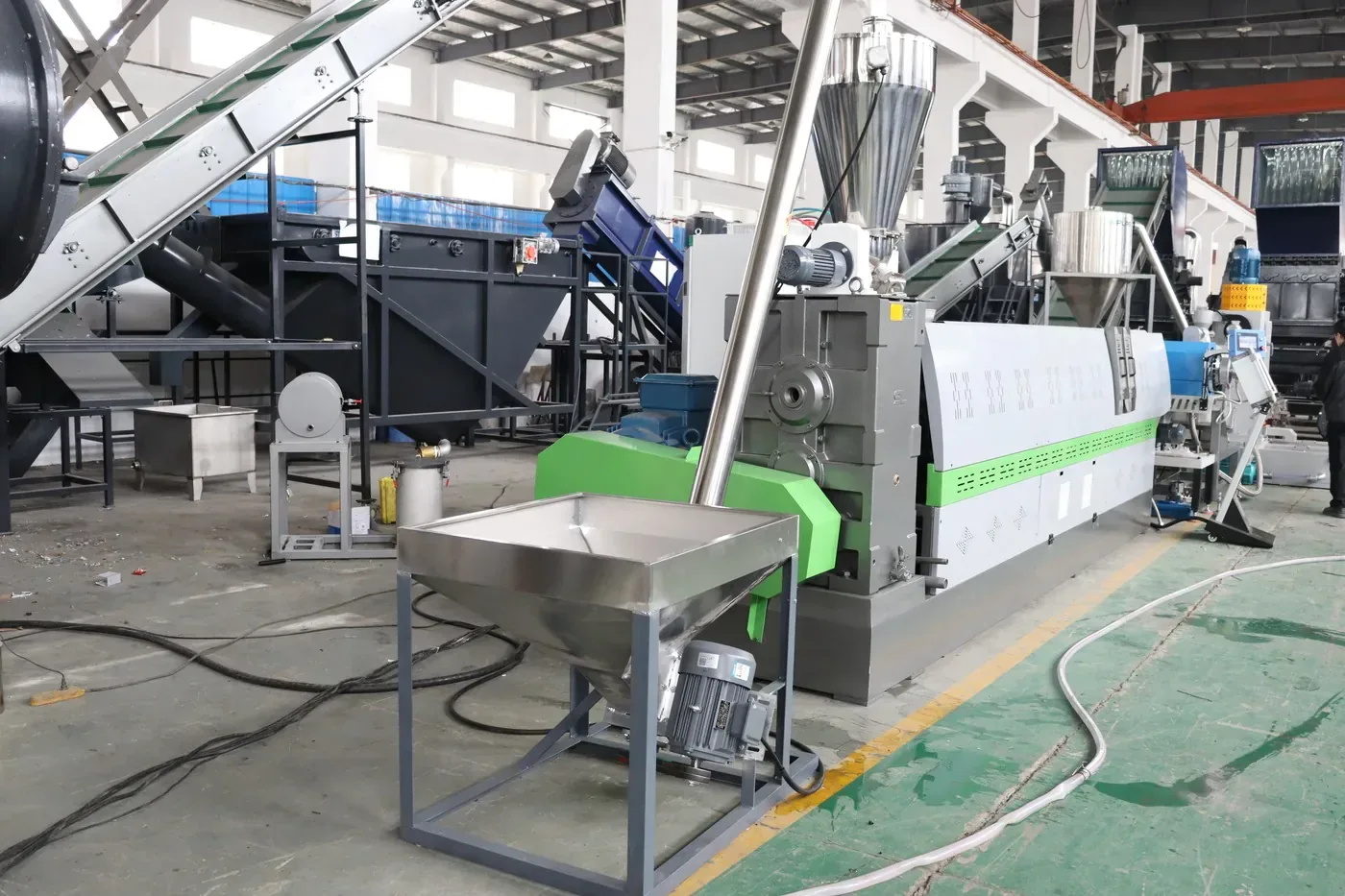
The film squeezer exists because of this specific problem. It is not a general-purpose dryer; it is a machine designed to remove water from film mechanically, and it is normally the stage that decides whether thermal drying is affordable at all.
Thermal drying removes what is left
Thermal drying — hot air, usually in a staged or belt dryer — removes the remaining surface moisture. Three practical points:
- Size it after the mechanical stage. A dryer sized for the moisture content leaving the
squeezer is much smaller than one sized for the moisture content leaving the washing tank.
- Airflow matters as much as temperature. Film mats easily, and a mat has a dry outside and a
wet inside. Good airflow through the material is what makes the dryer work.
- More heat is not more drying. Excess temperature can soften or degrade film without
removing additional water, and it raises energy cost for no benefit.
What moisture level is "dry enough"
There is no universal target. It is set by what happens next:
| Next step | What matters |
|---|---|
| Extrusion / pelletizing | Residual moisture becomes steam in the extruder and must be vented or degassed |
| Storage or baling | Moisture promotes heating, odour and biological activity in the bale |
| Sale as washed film | Moisture is weight the buyer pays for, and it affects downstream processing |
| Further washing | Additional moisture is largely irrelevant |
Because the target depends on the destination, the drying configuration is decided with the whole process route, not on its own.
Degassing is the backstop
Where moisture cannot be removed economically before extrusion, the extruder can be configured to remove it — vacuum venting, or a two-stage arrangement that exposes the melt twice. This is a legitimate route, but it is more expensive to run than removing water mechanically, so it is normally the second choice rather than the first.
A practical order of checks
- Is the dewatering stage actually working, or is material bypassing it?
- Is the material reaching the dryer in a mat, or spread enough for air to pass through?
- Is the dryer airflow adequate, and are the air paths clear?
- Is the moisture target being set by the downstream process, or has it been assumed?
- If moisture still exceeds the target, is degassing the right answer — or is the drying stage
undersized?
Relacionado: Qué hace cada máquina en una línea de lavado · Sistemas de lavado de plásticos · Soluciones para film de LDPE/LLDPE
SOBRE EL AUTOR
Equipo de ingeniería de Retech
Ingeniería de procesos y sistemas de reciclaje de plástico
El equipo de ingeniería de Retech trabaja en el análisis de materiales, diseño de procesos, configuración de líneas de reciclaje, pruebas de fábrica y puesta en marcha de proyectos.
Preguntas
How to Reduce Moisture After Film Washing — FAQ
¿Qué nivel de humedad debe alcanzar el film lavado?
Depende de lo que suceda a continuación. La extrusión, el almacenamiento y la venta toleran niveles diferentes. Por lo tanto, la configuración del secado se ajusta según el proceso posterior, en lugar de basarse en una cifra universal.
¿Puede una secadora reemplazar a una escurridora de película?
En principio es posible, pero su funcionamiento es mucho más costoso. Un sistema de compresión elimina el agua mediante fuerza a una fracción del coste energético por litro. El secado térmico se utiliza para eliminar lo que el deshidratado mecánico no puede.
¿Por qué mi película lavada sigue húmeda dentro de la paca?
La mayoría de las veces se debe a que el material llega al secador en forma de estera, por lo que el aire pasa alrededor de él en lugar de a través de él. La distribución del flujo de aire y la forma en que se presenta el material al secador suelen ser los primeros aspectos a comprobar, antes de considerar un secador más grande.
Más respuestas en las <a class="retech-x-link-arrow" href="/es/faq/">preguntas frecuentes completas</a>.
Más en conocimientos de proceso