

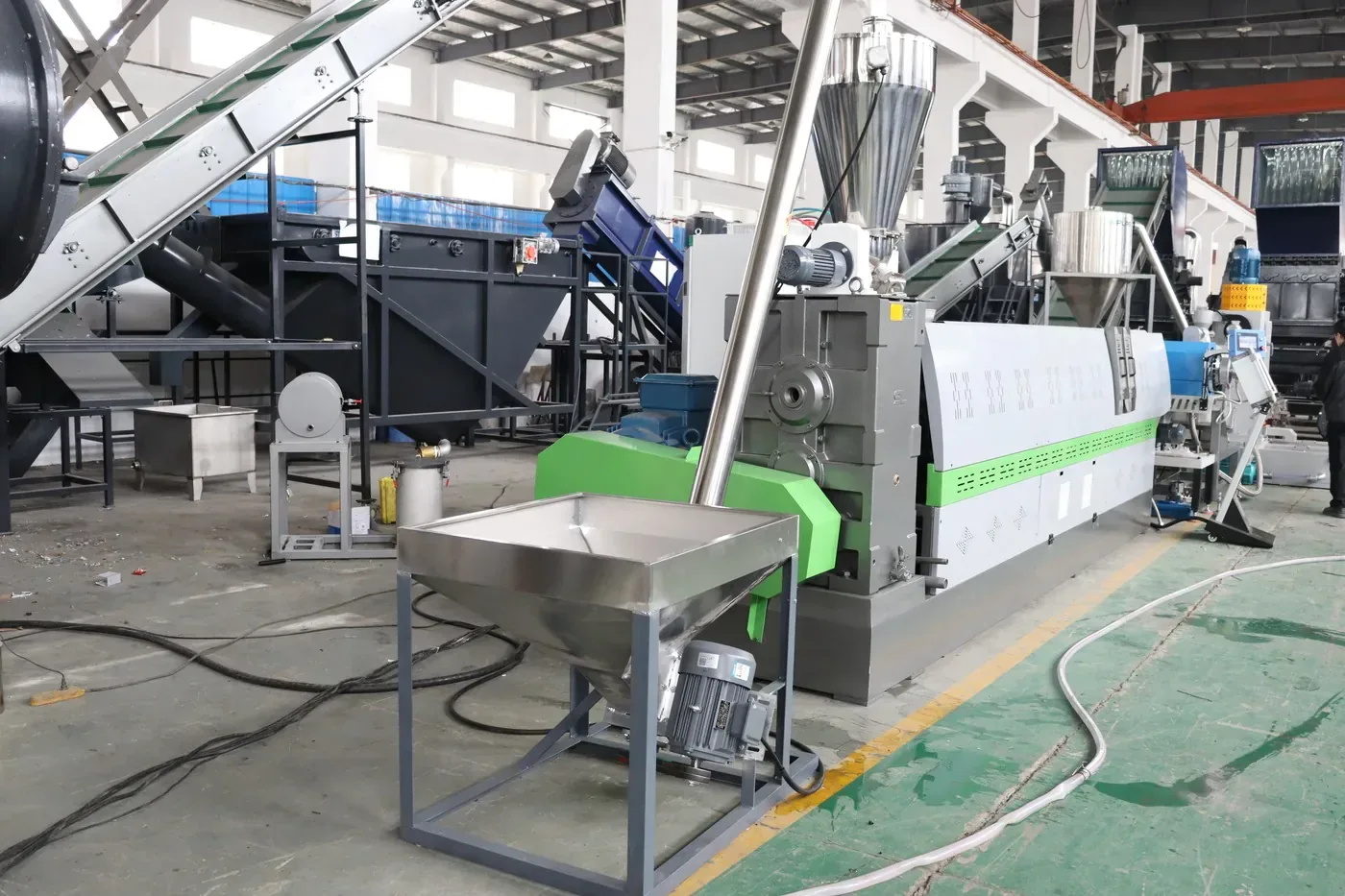
主要コンポーネント
クラッシャーブレードとスクリーン:出力品質を決定する部品
ブレードとスクリーンの2つの消耗品が、粒度、洗浄工程で達成可能な清浄度、そしてライン全体のランニングコストを決定します。.
クラッシャーブレードとスクリーン:出力品質を決定する部品
重要なポイント
- The screen sets the flake size; the blades set whether the material is cut cleanly or torn.
- Blunt blades do not just slow the crusher down — they generate fines, heat and dust that the washing stages then have to deal with.
- Blade material and hardness are chosen against the abrasiveness of the feed, not against a single best grade.
- Screen condition matters as much as screen size: blinded or damaged screens change the particle distribution without any change to the settings.
- Blade sharpening is a scheduled maintenance task, and it is normally cheaper than the quality loss from running blades past their life.
Why these two parts matter more than they look
A crusher does not have a single output specification. It has a particle-size distribution, and that distribution is produced by the interaction of the rotor blades, the fixed blades and the screen. Change any one of them and the material the washing line receives changes with it.
What the blades decide
The rotor blades cut the material against fixed bed knives. When the clearance between them is correct and the edges are sharp, the material is cut — a clean shear that produces flake with relatively few fines. As the edges wear, the machine begins to tear instead. Tearing produces three unwanted outputs:
- Fines that pass through the washing stages too quickly to be cleaned properly, and that are
often lost as waste.
- 熱 at the cut, which can soften or smear thermoplastic film.
- Dust, which is a handling and safety issue as well as a material loss.
This is why blade condition is a quality variable, not only a maintenance variable.
Blade material and hardness
Blade steel is selected against the feed. Abrasive streams — material carrying sand and grit, or glass-filled engineering plastics — wear edges quickly and justify a harder, more wear-resistant grade. Softer or more ductile grades hold up better against shock loads from occasional metal contamination.
Harder is not automatically better. A very hard blade can chip rather than wear when it meets something it cannot cut, and a chipped blade damages the rotor and the screen. The practical question is what the feed actually contains.
> Retech specifications list SKD-11 as the blade material on the published product data. Specific grades are confirmed per machine.
What the screen decides
The screen is the sizing element. Material stays in the cutting chamber until it is small enough to pass through the holes, so hole size directly sets the nominal flake size. Two consequences follow:
- Smaller holes do not automatically mean better output. They reduce throughput, increase
residence time and heat, and raise fines generation.
- Screen condition is as important as screen size. Blinded holes and damaged screens change
the effective opening without anyone changing a setting, which is why an unexplained shift in flake size is often a screen problem rather than a process problem.
The correct screen size is derived from what the downstream stages need: fine enough for the washing action to reach contamination, coarse enough that material still drains and conveys.
Rotor configuration
Rotor design determines how the material is presented to the cutting edge. Factors include the number of blades, their arrangement along the rotor, the rotor diameter and the chamber geometry. Different configurations suit different feed:
- Film and thin material needs a rotor geometry that keeps the material in the cutting zone
rather than letting it wrap.
- Rigid hollow parts need enough bite to break the part and enough chamber volume to clear it.
- Purge and thick sections need torque and a chamber that can hold the material long enough to
be reduced.
This is why two crushers rated at the same throughput can behave very differently on the same material.
Maintenance that actually protects output
- Check blade clearance, not just edge sharpness — clearance drift changes the cut before the
edge visibly wears.
- Inspect the screen for blinded holes, cracks and deformation whenever blades are changed.
- Sharpen on a schedule derived from the feed, not from a fixed calendar interval. Abrasive
feed wears edges faster.
- Keep metal out. Magnetic separation or metal detection upstream protects blades, screens and
the rotor in one decision.
- Record the sharpening interval. A shortening interval is an early signal that the feed has
changed.
関連情報: 機械タイプ · Shredder vs. Crusher · 製品 · Quality Assurance in the FAQ
著者について
プラスチックリサイクルプロセスおよびシステムエンジニアリング
Retechエンジニアリングチームは、材料分析、プロセス設計、リサイクルライン構成、工場試験、プロジェクトの試運転まで幅広く対応しています。.
質問
Crusher Blades and Screens: The Parts That Set Output Quality — FAQ
破砕機の刃はどのくらいの頻度で研磨する必要がありますか?
交換間隔は、供給物の研磨性と機械の稼働負荷によって異なります。固定の間隔を設けるのではなく、稼働状況を追跡してください。研磨の間隔が短くなり続けている場合は、刃の劣化ではなく、供給物の性質が変化したことを示唆しています。.
スクリーン穴が小さいほど、よりきれいなフレークが得られますか?
それ単体では解決しません。穴が小さいと処理能力が低下し、滞留時間と熱が増加するため、微粉や汚れの原因となる可能性があります。フレークサイズは洗浄および押出工程の要件に合わせて設定すべきであり、汚染物質は洗浄工程で除去されます。.
フレークサイズが急激に変化する原因は何ですか?
まずスクリーンを確認してください。目詰まり、破損、変形があると、機械の設定を変更しなくても有効開口面積が変化します。次に、刃のクリアランスと供給物の構成を確認してください。.
その他の回答は <a class="retech-x-link-arrow" href="/ja/faq/">FAQ全文</a>.
コアコンポーネントの詳細