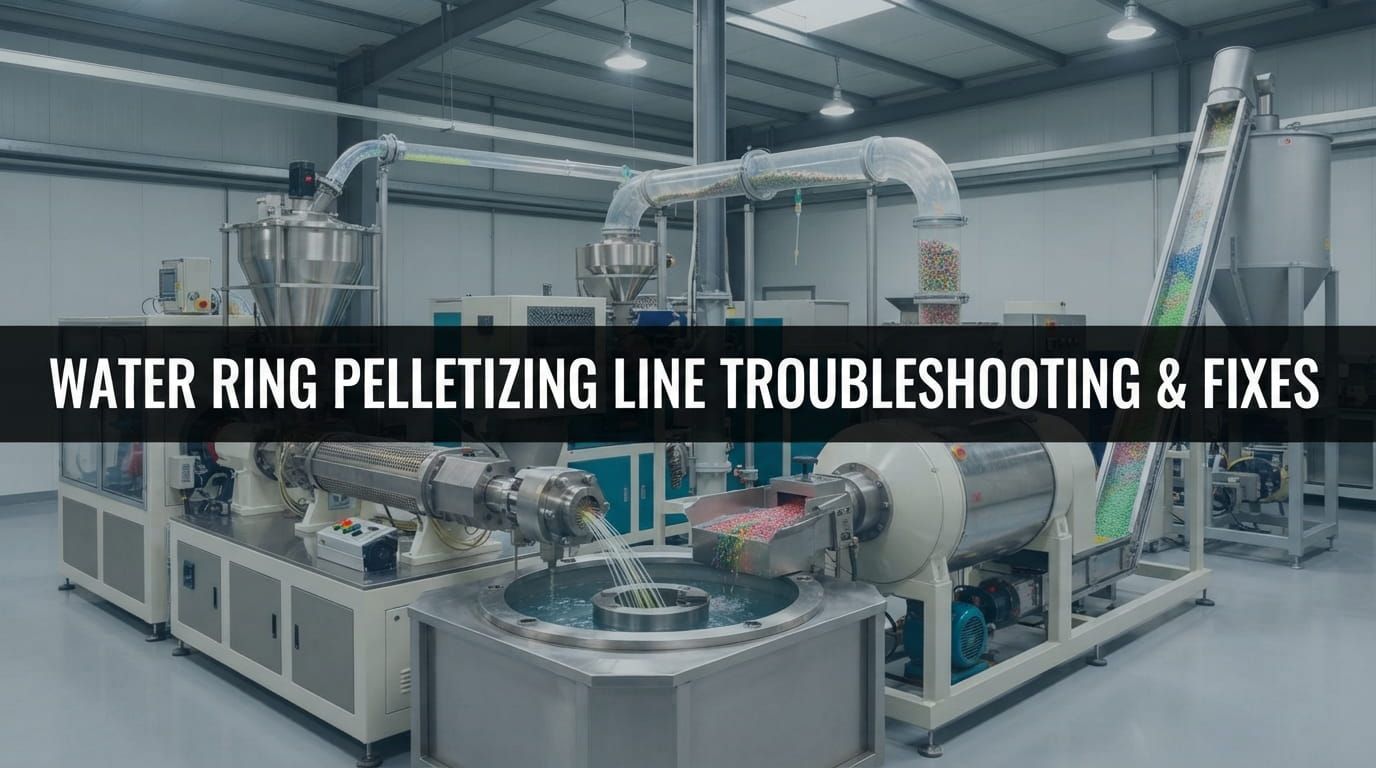
Operating a water ring granulation production line requires precise control over temperature, mechanical alignment, and material feeding to ensure stable output. When processing polyolefin regrind such as HDPE or PP flakes, unexpected operational hiccups can disrupt plant efficiency and lower pellet quality.
This technical guide outlines the common faults, root causes, and practical engineering solutions for the water ring pelletizing system to help plant operators minimize downtime.
1. Extruder Fails to Rotate
When the main extruder suddenly stops rotating, production comes to an immediate halt. Ignoring this issue risks severe damage to the gearbox and drive motor.
- Root Causes: Unmelted metal foreign objects entering the screw flights, or barrel temperature zones set too low to plasticize the material properly.
- Engineering Solutions: Safely shut down the system, remove and clean the contaminated screw, and ensure upstream metal detectors are fully operational. Raise the heating temperature to the specified processing point before attempting a restart.
2. Temperature Cannot Rise to Target Value
An extruder heating zone that fails to reach its target temperature creates uneven melting and triggers pressure fluctuations.
- Root Causes: Damaged heating rings, a single-phase switch turned off in the electrical cabinet, or a broken thermocouple sensor.
- Engineering Solutions: Test and replace damaged heating rings immediately. Check the electrical cabinet to ensure the single-phase switch is closed. Replace broken thermocouples to restore accurate temperature feedback.
3. Material Overflow at the Vent Port
Melt pushing out of the vacuum vent port indicates severe flow restriction or volatile buildup inside the barrel.
- Root Causes: Impure raw materials, a clogged screen changer, excessively low die head temperature, or a blocked die lip.
- Engineering Solutions: Replace the clogged filter screen to relieve back pressure. Raise the die head temperature and clean the die lip thoroughly. If contamination is severe, pull and clean the main screw.
4. Pellets Clump and Cannot Separate
When output granules stick together instead of separating into clean water ring pellets, downstream packaging and cooling efficiency suffer.
- Root Causes: Excessive mechanical gap between the rotating cutter and the die lip, notches on the cutter blade, overly high water temperature, or insufficient water flow.
- Engineering Solutions: Dismount and readjust the cutter assembly so the blades fit tightly against the die lip. Lower the cooling water temperature or increase the water supply to ensure rapid pellet solidification.
5. Uneven Pellet Size
Inconsistent pellet dimensions create quality control rejections and complicate subsequent injection molding or film blowing processes.
- Root Causes: Excessively high main extruder speed leading to unstable material discharge and starving at the feeding throat.
- Engineering Solutions: Reduce the main machine speed to match the stable feeding rate. Maintain a consistent and sufficient material level at the feed throat to stabilize output.
Essential Safety Protocols for Maintenance and Operation
Proper troubleshooting must always align with strict plant safety rules to protect operators from high-temperature and mechanical hazards:
- Electrical Safety: Cut off all relevant power supplies completely before entering the compactor bin or inspecting electrical components. Clean contactors thoroughly if the machine has been idle to prevent dust-induced sparks.
- Personal Protection: Operators must wear gloves, protective goggles, and high-temperature gear when replacing filter screens, inspecting vacuum vents, or disassembling molds and screws to prevent steam and thermal burns.
- Metal Detection: When the metal detector alarms, inspect the belt conveyor immediately and restart the line only after all metal contaminants are fully removed.
Optimize Your Recycling Line Performance with Retech Machine
Preventing frequent equipment faults begins with choosing robust, well-engineered recycling machinery designed for demanding industrial environments.
Retech Machine manufactures high-performance plastic recycling systems, including advanced plastic pelletizing lines, heavy-duty shredders, and industrial extruders engineered for long-term operational stability.
Contact the Retech Machine engineering team today for technical support, replacement parts, or customized plant layouts to keep your recycling facility running at peak efficiency.
ABOUT THIS UPDATE
Published by Retech Marketing & Communications Team
The Retech Marketing & Communications Team publishes official company news, exhibition information, factory updates, project milestones and product announcements.
For technical questions about plastic recycling systems, please contact our engineering team.