
Configuration & Options
Why Film and Fibre Need Compaction Before Extrusion
Low bulk density is the single biggest constraint in film and fibre recycling. Compaction is how it is solved.
Why Film and Fibre Need Compaction Before Extrusion
Key takeaways
- Bulk density, not throughput, is what limits how much film and fibre an extruder can accept.
- Feeding loose film directly to an extruder leads to surging, unstable melt pressure and inconsistent pellets.
- A compactor cuts, heats and densifies the material into a consistent mass before it enters the screw.
- Compaction also drives off some surface moisture as a side effect.
- It is the reason a compactor-pelletizing line can run film at a stable rate that a direct-feed extruder cannot.
The problem: bulk density
An extruder is a volumetric device at the feed throat. It accepts a certain volume per revolution, and that volume has a mass attached to it. For rigid flakes that mass is substantial. For loose film it is very small.
The consequence is that an extruder rated at a given output in kilograms per hour will only reach it on material of a certain bulk density. Feed it loose film and the screw flights are not filled; the material is not conveyed consistently; melt pressure fluctuates; and the output falls well below the rating no matter how the machine is set.
This is why bulk density, not throughput, is the constraint in film and fibre recycling.
What happens without compaction
Feeding loose film or fibre directly to an extruder typically produces:
- Surging — the feed alternately bridges and collapses, so the mass flow rate oscillates.
- Unstable melt pressure, which shows up at the die as varying pellet size.
- Unmelted particles, because residence time is inconsistent.
- Low achievable output, often far below the machine's nominal rating.
- Higher specific energy, because the extruder is running under conditions it was not designed for.
How a compactor feeder works
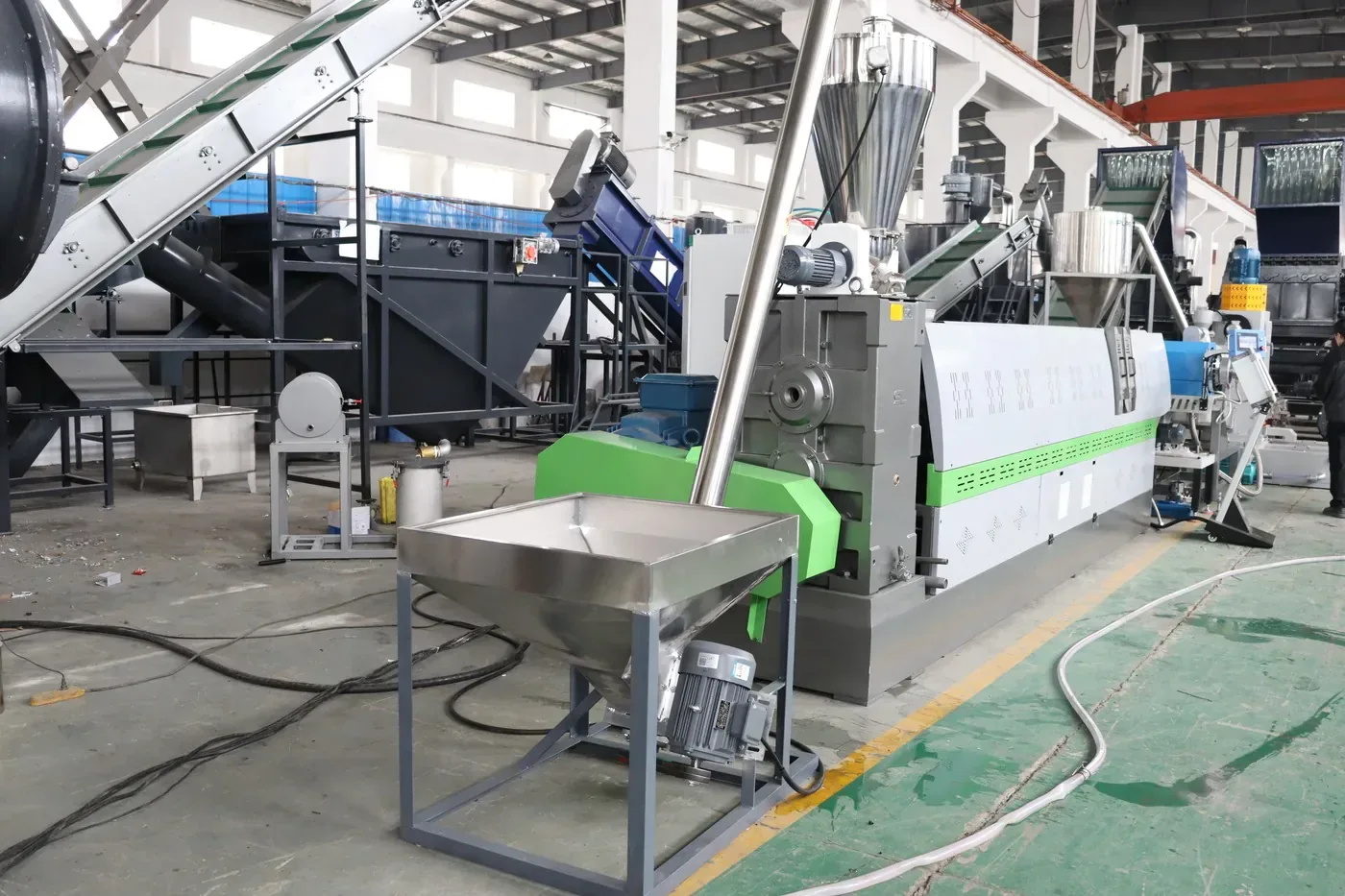
The material enters a compactor — usually a vertical chamber with rotating blades — where it is cut, mixed and heated by friction without being fully melted. The combined effect is:
- Size reduction of the incoming film or fibre.
- Densification into a crumb-like mass with far higher bulk density.
- Partial drying, as surface moisture is driven off by the friction heat.
- Homogenisation, so the material presented to the screw is consistent.
The densified material is then fed into the extruder screw under controlled conditions. Because the feed is now consistent in density and temperature, the screw fills properly and the process stabilises.
What compaction changes downstream
- Stable melt pressure at the die, which is what makes pellet size consistent.
- Higher achievable output from the same extruder, because the flights are actually filled.
- Better filtration behaviour, because the melt is more homogeneous when it reaches the screen.
- Less moisture to remove thermally, because part of it was driven off in the compactor.
When compaction is required
Compaction is normally required where the feed has very low bulk density:
- LDPE, LLDPE and stretch film
- PP and PE woven bags and raffia
- Nonwoven and fibre waste
- Heavily printed or laminated film
- Any feedstock that has been baled and retains a low density after opening
It is usually not required for washed rigid flakes, regrind or denser container material, which feed an extruder directly.
The decision is made from the measured bulk density of the actual material — a figure that is established during project discussion rather than assumed.
Relationship to the rest of the line
Compaction is not an isolated choice. It interacts with:
- Washing and drying upstream — wetter feed needs more work in the compactor.
- Degassing downstream — moisture not removed in the compactor must be vented later.
- Filtration — a homogenised melt blinds a screen more evenly and predictably.
- Single vs. two-stage pelletizing — compaction often changes which one is appropriate.
Related: Single-Stage vs. Two-Stage Pelletizing · LDPE/LLDPE Film Solutions · Plastic Pelletizing Systems
ABOUT THE AUTHOR
Plastic Recycling Process & System Engineering
The Retech Engineering Team works across material analysis, process design, recycling line configuration, factory testing and project commissioning.
Questions
Why Film and Fibre Need Compaction Before Extrusion — FAQ
Can I feed film directly into an extruder without a compactor?
It can be done where the material is already dense or pre-densified, but loose film typically causes surging, unstable melt pressure and output well below the machine rating. Compaction is what makes film output stable.
Does a compactor dry the material as well?
It removes some surface moisture as a side effect of the friction heat, but it is not a dryer. Moisture that the compactor does not remove has to be handled by drying upstream or degassing downstream.
How do I know whether my material needs compaction?
From its bulk density. Very low bulk density feed — film, bags, fibre, nonwoven — needs compaction; washed rigid flake and regrind normally do not. The figure is established during project discussion.
More answers in the <a class="retech-x-link-arrow" href="/faq/">full FAQ</a>.
More in Configuration & Options