


Recycling PET bottles is already a mature industry. Recycling PET fabrics, however, is an entirely different engineering challenge.
Garment factory offcuts, used polyester clothing, home textile waste, and industrial fiber scraps do not behave like rigid plastics. They are soft, entangled, dyed, blended with other fibers, and often contaminated with oils, labels, metals, and finishing chemicals. If the same recycling logic used for bottles is applied to fabrics, the line will quickly clog, the washing will be ineffective, and the final IV of PET will collapse during melting.
This is why PET textile recycling has gradually evolved into a specialized recycling discipline with its own process logic, equipment configuration, and control philosophy.
In modern plants, the mainstream solution is still physical recycling, focused on producing recycled polyester fiber and fiber-grade pellets, while chemical recycling is reserved for high-end applications.
Why Sorting PET Fabrics Is Much More Complex Than Bottle Recycling
The raw materials mainly include:
Garment polyester offcuts
Used polyester garments
Home textile waste
Industrial PET fiber scraps
Unlike bottles, fabrics contain:
Cotton, spandex, nylon blends
Metal zippers and buttons
PP/PE labels and sewing threads
Oil stains, dyes, and finishing agents
Heavy dust contamination
Before entering the line, materials must go through:
Manual pre-sorting for large impurities
Metal removal via eddy current separators
NIR optical sorting for material and color control (purity ≥98%)
Density separation using saltwater flotation based on PET’s density of 1.38 g/cm³
Proper sorting is not just about cleanliness — it directly determines how difficult the washing stage will be and how stable the IV can be maintained later.
The Real Core: Making Fabrics “Washable”
The biggest problem with textiles is entanglement. Long fibers wrap around shafts, resist washing, and trap contaminants inside.
Therefore, the first stages are not about size reduction, but about structure destruction.
Pre-shredding to Prevent Tangling
A low-speed, high-torque single-shaft shredder cuts fabrics into 50–100 mm strips. This prevents wrapping and ensures stable feeding.
Crushing and Fiber Opening — The Step That Defines Success
After coarse crushing into 10–30 mm pieces, a fiber opener (carding machine) turns compact fragments into fluffy, separated fibers.
This step is unique to textile recycling.
Often, an alkaline pre-treatment (5–10% NaOH at 45–55°C) is applied here to:
Remove dyes and finishing oils
Break fiber cohesion
Prepare materials for deep washing
At this point, the material finally becomes washable.
Multi-Stage Washing: Where Final Quality Is Determined
Once fibers are opened, effective washing becomes possible.
Ambient friction washing removes dust
Hot washing at 80–95°C with NaOH and surfactants removes oils, dyes, and chemicals
Friction washers provide mechanical scrubbing
2–3 stage counter-current rinsing ensures neutral pH
The wastewater at this stage contains high COD, SS, and dye content, requiring coagulation, air flotation, biological treatment, and decolorization. Modern systems allow 80–95% water reuse.
Moisture Control: The Key to Preventing IV Degradation
After washing:
Centrifugal or screw dewatering reduces moisture to ≤8%
Hot air or fluidized bed drying at 120–160°C reduces moisture to ≤0.5%
This is critical. Excess moisture during melting is the primary reason PET molecular chains break and IV drops.
From Clean Fibers to Pellets or Recycled Polyester Fiber
Melt Granulation
Using a high-torque twin-screw extruder:
250–280°C melting
Vacuum devolatilization<0.3 kPa
Underwater pelletizing
IV drop can be controlled within 5%.
Fiberization — The Main Value Output
Most PET fabric recycling lines aim at fiber production:
Melt → Spinning → Drawing → Crimping → Cutting
Applications include yarn spinning, non-wovens, filling materials, geotextiles, and automotive interiors.
When Physical Recycling Is Not Enough: Chemical Depolymerization
For mixed colors or heavily contaminated textiles, alkaline hydrolysis or alcoholysis breaks PET into PTA and EG, followed by purification and repolymerization into food-grade PET with 99.9% purity.
This route is costly but suitable for high-value markets.
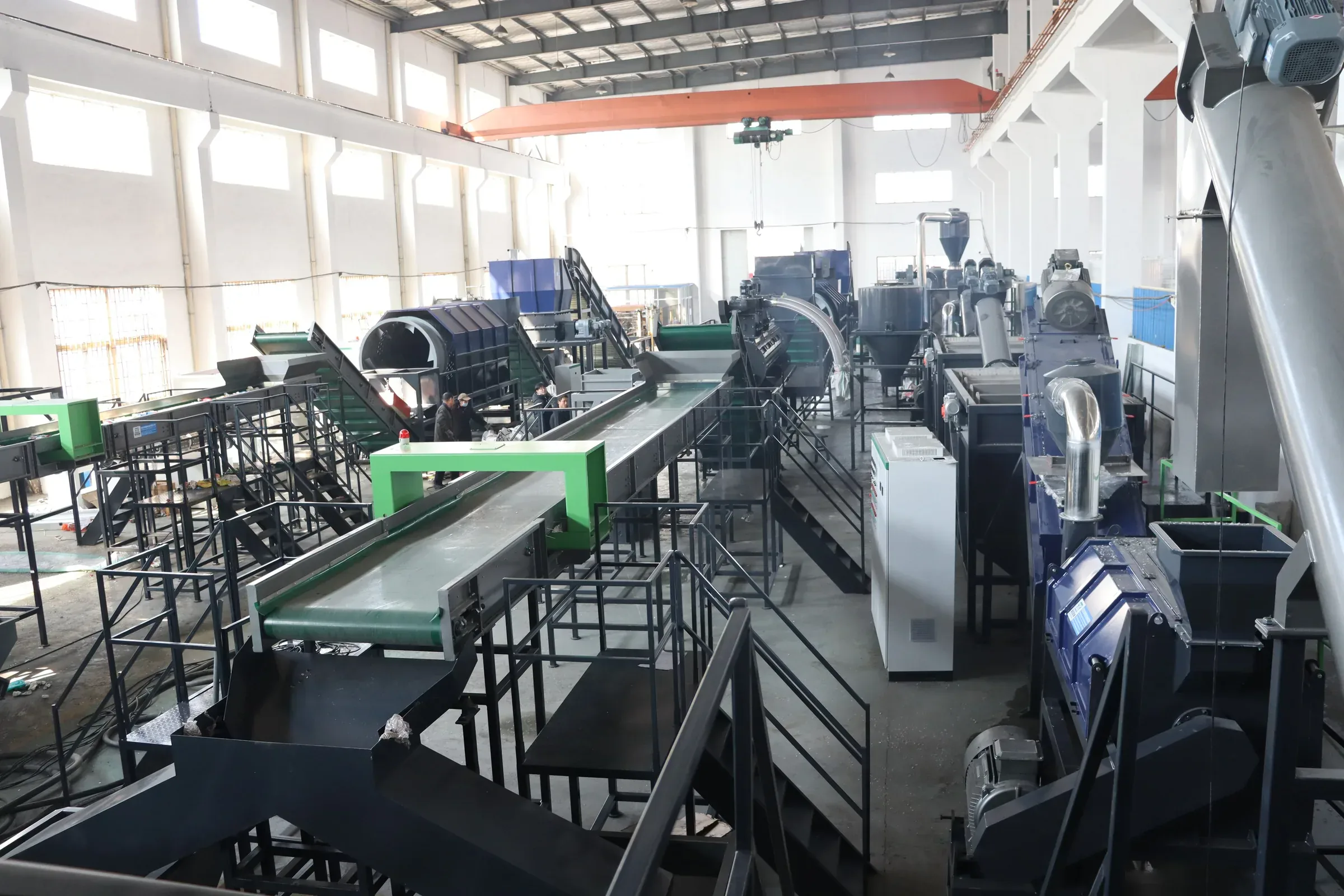
Key Equipment in a PET Fabric Recycling Line
Shredder
Metal separator
Crusher
Fiber opener
Friction washer
Rinsing tanks
Dewaterer
Dryer
Twin-screw extruder + underwater pelletizer
Wastewater treatment system

Product Quality and Applications
- Recycled pellets: fiber grade, injection grade, blow molding grade
- Recycled fibers: apparel, home textiles, non-wovens, automotive
- Quality targets:
IV ≥ 0.6 dl/g
Moisture ≤ 0.5%
Ash ≤ 0.1%
Impurities ≤ 50 ppm
Costs and Environmental Performance
- Physical recycling: 800–1,500 RMB/ton
- Chemical recycling: 3,000–5,000 RMB/ton
- Pellet value: 3,000–5,000 RMB/ton
Water reuse up to 95%, with exhaust and sludge properly treated.
Conclusion
PET textile recycling is not a simplified version of bottle recycling. It is a fiber-oriented recycling technology built around:
Preventing entanglement
Opening fibers before washing
High-temperature impurity removal
Strict moisture control to protect IV
Effective wastewater reuse
When these principles are correctly applied, waste polyester textiles can be transformed into high-quality recycled fibers and pellets, completing the circular lifecycle of polyester materials.
This article is carried over from the Retech technical archive and keeps its original URL.
ABOUT THIS UPDATE
Published by Retech Marketing & Communications Team
The Retech Marketing & Communications Team publishes official company news, exhibition information, factory updates, project milestones and product announcements.
For technical questions about plastic recycling systems, please contact our engineering team.

